Obstacles to Moral Action

Explore how Thomas Aquinas transforms 13th-century ethics into a blueprint for modern life. Join elite scholars as they bridge the gap between ancient habits and contemporary character development, revealing how our first moral choices and the “architecture of consent” continue to shape our journey toward virtue and human flourishing.

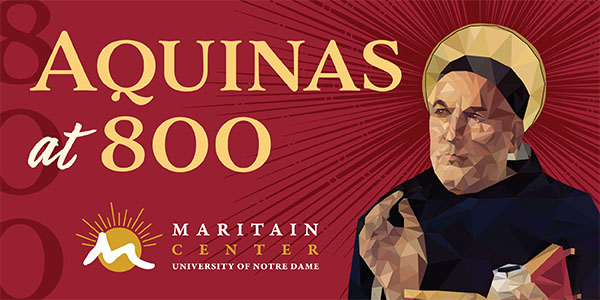
The comprehensive and systematic character of Thomas Aquinas’ thought has for centuries informed inquiry into questions of human dignity, freedom, economic development, work, poverty, the environment, and other issues of global significance. Celebrate the 800th anniversary of the birth of Thomas Aquinas, exploring the ongoing importance of his thought to contemporary cultural, philosophical, and theological discussions. In gathering many of the most accomplished contemporary scholars of Aquinas’ thought from throughout the world working on themes in Ethics, Metaphysics, Epistemology, Anthropology, Political Theory, Christology, Trinitarian Theology, Sacramental Theology and Ecclesiology, among others, this series promotes fruitful interchange of diverse perspectives on the importance of Aquinas in the world today.

The “Aquinas at 800” conference serves as a pivotal academic milestone, modernizing Thomistic ethics for a contemporary audience. By translating 13th-century metaphysics into a “first-person” ethics of the agent, the conference provides a framework for understanding how character is not merely a collection of rules, but a dynamic architecture of choice and intentionality.
José M. Torralba begins by evaluating the “Aristotelian Circle,” which posits that moral virtue requires prudence, yet prudence requires virtue. To break this deadlock, Torralba highlights Aquinas’s concept of synderesis—the innate knowledge of universal moral principles. Unlike Aristotle’s potentially deterministic focus on childhood habituation, Aquinas incorporates Averroes’ definition of habitus as “that which one uses at will.” This distinction is vital; it suggests that habits are not automatic triggers but tools the will employs freely. Access to the “natural rule” enables moral transformation and conversion through rational effort.
Robert Barry explores the “First Moral Act” at the “Age of Reason.” While the threshold is variable, Aquinas recognizes legal benchmarks at age 12 for girls and 14 for boys. Initially governed by sensitive powers, children are hindered by “humidity in the brain” inhibiting rational operations. Transitioning to agency requires “consent” as a filter. Barry utilizes an “elevator versus stairs” analogy to explain this: if a child is deeply habituated toward sensitive goods, the higher good of God might not even “rise to the level of choice”; it is filtered out before deliberation begins. Prior non-rational education makes this first act of “ordering oneself” a high-stakes threshold of freedom.
Isabel Lemaître Palma contrasts Anselm’s “double inclination” of the will with Aquinas’s focus on metaphysical finitude. For Aquinas, evil in perfect creatures, like angels, does not stem from desiring “evil.” Rather, because creatures are not their own rule or measure, they can act without considering the divine norm. This is the “non-consideration” of the rational rule. Sin occurs when an agent pursues a genuine good—such as natural happiness—out of its proper order. This metaphysical insight clarifies how the fall of the spiritual creature is an internal collapse of order rather than an external attraction to vice. Moral failure is rooted in the failure to order finite goods toward the Infinite.
These medieval mechanics of choice are critical for contemporary character education because they shift the focus from “what is right to do” to “what is good to be.” Understanding synderesis, the filtering mechanism of consent, and the reality of disordered goods provides a map for navigating moral growth. This framework asserts that the light of natural reason provides a permanent possibility for change, moving us from a legalistic “act ethics” toward a transformative “agent ethics” that honors the human person. By grounding ourselves in this 13th-century wisdom, we rediscover the dignity of free choice and the profound hope of moral redemption within the landscape of modern life.

  • The Shift from Act to Agent. Contemporary ethics is moving from a “third-person” legalistic view focused on the rightness of specific results toward a “first-person” perspective focused on the agent’s intention. This shift emphasizes that how we perceive and intend our actions is the primary driver of character formation.
  • Synderesis as a Tool for Change. While Aristotle believed bad habits were nearly impossible to break in adulthood, Aquinas introduces synderesis—an innate spark of universal moral knowledge. This means that no matter one’s upbringing, the human mind retains a baseline access to the good, making moral “re-tooling” and conversion always possible.
  • The Complexity of the First Moral Choice. The transition to the “Age of Reason” is not a single calendar date but a sophisticated psychological threshold where a person moves from animal-like preference to rational consent. Aquinas recognizes this threshold is variable, but often coincides with the legal benchmarks of 12 for girls and 14 for boys.
  • Habit vs. Willful Use (Habitus). Following the tradition of Averroes, Aquinas defines a habit (habitus) as something a person uses “at will.” This preserves human freedom, suggesting that even deeply ingrained dispositions require a fresh act of the will to be exercised, providing a “gap” where intentionality can intervene.
  • Evil as Disordered Good. Evil is rarely the pursuit of “badness” for its own sake; rather, it is the pursuit of a legitimate good outside the proper order of reason. Understanding this helps us identify how even “good” goals can lead to ethical failure when they ignore the higher “measure” of the natural law.

  • “We are moving from an ethical model in which the decisive question is ‘what it is right to do’ to one in which the critical question is ‘what is good to be’.” — José M. Torralba
  • “Aquinas defines habit as ‘what a person uses at will’… The will is a capacity for free choice. Thus, Aquinas would interpret our dispositions not in Aristotle’s deterministic way.” — José M. Torralba
  • Rebutting the charge of Pelagianism by clarifying that human power is always moved by the Divine, Barry notes: “When a man is said to do what is in him to do, this is said to be in his power according as he is moved by God.” — Robert Barry (citing Aquinas)
  • “The first thing that occurs to a man is to think about himself and to deliberate about himself… if he does not then direct himself to the due end, he will sin mortally.” — Robert Barry
  • “Sin in the rational creature… is possible because the non-consideration of the rule of reason that directs the act is possible in any creature.” — Isabel Lemaître Palma

Religion and PhilosophyThe Jacques Maritain CenterThomas AquinasUniversity of Notre DameCatholic Social TeachingPhilosophy

More Like This

Related Posts

Let your curiosity roam! If you enjoyed the insights here, we think you might enjoy discovering the following publications.
Stay In Touch

Subscribe to our Newsletter


To receive the latest and featured content published to ThinkND, please provide your name and email. Free and open to all.

Name
This field is hidden when viewing the form
What interests you?
Select your topics, and we'll curate relevant updates for your inbox.
Affiliation