

Meaningful Work with Guru Madhavan and Chris Higgins

Kick off the 2025-2026 series with a conversation with two contributors from the August 2025 issue of the Virtues & Vocations magazine, focused on meaningful work. Guru Madhavan is the Norman R. Augustine senior scholar and senior director of programs for the U.S. National Academy of Engineering. Chris Higgins is the Chair of the Department of Formative Education at Boston College. He recently published Undeclared: A Philosophy of Formative Higher Education with MIT Press. Join us for a conversation about the purpose of education and how universities can educate for flourishing.
Experience the Event

Kick off the 2025-2026 series with a conversation with two contributors from the August 2025 issue of the Virtues & Vocations magazine, focused on meaningful work. Guru Madhavan is the Norman R. Augustine senior scholar and senior director of programs for the U.S. National Academy of Engineering. Chris Higgins is the Chair of the Department of Formative Education at Boston College. He recently published Undeclared: A Philosophy of Formative Higher Education with MIT Press. Join us for a conversation about the purpose of education and how universities can educate for flourishing.
Learn more at the Virtues & Vocations website. Register to receive emails about Virtues & Vocations below.
MoreMeet the Speaker: Chris Higgins
Chris Higgins coordinates the program in Transformative Educational Studies and co-directs the Formative Leadership Education Project at Boston College. A philosopher of education, Higgins seeks to articulate the existential dimensions of teaching and learning, defend the idea of education as a public good, and recall education to its humane roots. He has written on: the dynamics of the teacher-student relationship; action research and the philosophy of inquiry; ignorance and openmindedness; humanism and liberal learning; imagination and aesthetic education; practice and vocational formation, and the experimental tradition in higher education. He recently published Undeclared: A Philosophy of Formative Higher Education with MIT Press. His book, The Good Life of Teaching: An Ethics of Professional Practice (Wiley-Blackwell, 2011) offers one of the first systematic extensions of virtue ethics to questions concerning work and professional identity. His current book project, entitled Humane Learning: Formative Essays on Educational Integrity, is an inquiry into the problems and possibilities of formative higher education.
Meet the Speaker: Guru Madhavan
Guru Madhavan is the Norman R. Augustine Senior Scholar and senior director of programs of the National Academy of Engineering. He has served as a technical advisor to the U.S. Department of Health and Human Services and the European Union Malaria Fund. Previously in the medical device industry, he has contributed to the research and development of surgical catheters for cardiac ablation and neuromuscular stimulators for improving blood circulation.
A systems engineer by background, he received his M.S. and Ph.D. in biomedical engineering and an M.B.A. from the State University of New York that awarded him the Edward Weisband Distinguished Alumni Award for Public Service or Contribution to Public Affairs. His recent awards include: ASME Henry Laurence Gantt Medal for business leadership, AAMI Laufman-Greatbatch Award for contributions to health technology, IEEE Norbert Weiner Award for Social and Professional Responsibility, IEEE Alfred Goldsmith Award for Outstanding Achievement in Engineering Communication, and IEEE-USA Award for Distinguished Literary Contributions Furthering Public Understanding and the Advancement of the Engineering Profession and the George F. McClure Citation of Honor for engineering leadership, and an honorary doctorate from SUNY Polytechnic Institute. He is an elected fellow of IET, AAAS, AIMBE, and ASME, a companion of the Royal Aeronautical Society, and a member of the European Academy of Sciences and Arts.
His books include the nonfiction Applied Minds: How Engineers Think and Wicked Problems: How to Engineer a Better World (W.W. Norton and others internationally).
Wicked Problems: How to Engineer a Better World
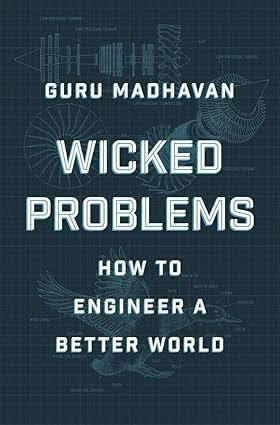
Our world is filled with pernicious problems. How, for example, did novice pilots learn to fly without taking to the air and risking their lives? How should cities process mountains of waste without polluting the environment? Challenges that tangle personal, public, and planetary aspects—often occurring in health care, infrastructure, business, and policy—are known as wicked problems, and they are not going away anytime soon.
In linked chapters focusing on key facets of systems engineering—efficiency, vagueness, vulnerability, safety, maintenance, and resilience—engineer Guru Madhavan illuminates how wicked problems have emerged throughout history and how best to address them in the future. He examines best-known tragedies and lesser-known tales, from the efficient design of battleships to a volcano eruption that curtailed global commerce, and how maintenance of our sanitation systems constitutes tikkun olam, or repair of our world. Braided throughout is the uplifting tale of Edwin Link, an unsung hero who revolutionized aviation with his flight trainer. In Link’s story, Madhavan uncovers a model mindset to engage with wickedness.
An homage to society’s innovators and maintainers, Wicked Problems offers a refreshing vision for readers of all backgrounds to build a better future and demonstrates how engineering is a cultural choice—one that requires us to restlessly find ways to transform society, but perhaps more critically, to care for the creations that already exist.
Click here for more information.
Create the Future Podcast - How Do Engineers Think? with Guru Madhavan
In this episode of the Create the Future podcast, acclaimed biomedical engineer and policy adviser, Guru Madhavan, is asked “how do engineers think?”
Along the way, Guru describes how he started down the path of investigating the engineering mindset, why he advocates for engineers to engage with the arts, and how he applies his systems engineering background to his work. We discuss the origins of the word “engineering”, hear about the similarities between evolution and innovation, and learn what it means to be a barefoot engineer.
Click here to listen to the podcast.
Undeclared - A Philosophy of Formative Education
An imaginative tour of the contemporary university as it could be: a place to discover self-knowledge, meaning, and purpose.

What if college were not just a means of acquiring credentials, but a place to pursue our formation as whole persons striving to lead lives of meaning and purpose? In Undeclared, Chris Higgins confronts the contemporary university in a bid to reclaim a formative mission for higher education. In a series of searching essays and pointed interludes, Higgins challenges us to acknowledge how far our practices have drifted from our ideals, asking: What would it look like to build a college from the ground up to support self-discovery and personal integration? What does it mean to be a public university, and are there any left? How can the humanities help the job-ified university begin to take vocation seriously?Cutting through the underbrush of received ideas, Higgins follows the insight where it leads, clearing a path from the corporate multiversity to the renaissance in higher education that was Black Mountain College and back again. Along the way, we tour a campus bent on becoming a shopping mall, accompany John Dewey through a midlife crisis, and witness the first “happening.” Through diverse and grounded philosophical engagements, Undeclared assembles the resources to expand the contemporary educational imagination.
Click here for more information.
To Advocate for Vocational Education is Really to Argue for the Humanities
Excerpt: Is the contemporary university too detached from the working world or already too vocationalised? The champions of the bottom line stress “transferable skills” and marketable degrees. The humanities stalwarts point out that life, as Wordsworth saw, is about more than “getting and spending”. And indeed it is, but so is vocation. Both sides assume that vocational education is nothing more than training and credentialing. By my count, this omits no fewer than four necessary tasks of vocational formation.
Click here to read the full article.