

Why Mindset Matters

Join us for a discussion with Daniel Porterfield, president and CEO of the Aspen Institute, a former college president, and the author of Mindset Matters: The Power of College to Activate Lifelong Growth about mindsets, character formation, and higher education.
Experience the Episode
Monday, May 12, 2025 12:00 pm

Join us for a discussion with Daniel Porterfield, president and CEO of the Aspen Institute, a former college president, and the author of Mindset Matters: The Power of College to Activate Lifelong Growth about mindsets, character formation, and higher education.
Learn more at the Virtues & Vocations website. Register to receive emails about Virtues & Vocations below.
MoreMeet the Speaker: Dan Porterfield
Since 2018, Daniel R. Porterfield, Ph.D. has served as President and CEO of the Aspen Institute—a global nonprofit organization founded in 1949 to ignite human potential to build understanding and create new possibilities for a better world. He has been recognized as a visionary strategist, leader, and advocate for young people and purpose-driven leadership. A lifelong educator and former college president, he is the author of the 2024 book, Mindset Matters: The Power of College to Activate Lifelong Growth.
At the Aspen Institute, Porterfield has led an era of organizational development and growth. Since 2018, fueled by new investments, the Institute’s operating budget has increased from $158 million to more than $260 million, and its endowment has tripled to more than $350 million.
Highlights of Porterfield’s tenure include:
The 2024 creation of the Institute’s Center for Rising Generations, which develops the leadership of youth and young adults, powered by an historic $185.7 million endowment gift from the Bezos Family Foundation;
The revitalization of the Institute’s Aspen Meadows campus in Colorado, including a full hotel renovation and the creation of the Resnick Center for Herbert Bayer Studies, a $20 million gallery and learning space dedicated to the art and ideas of the Bauhaus master Herbert Bayer who was one of the Institute’s founders; and
The launch of major new partnerships, including investments of nearly $40 million to foster inclusive economic growth; more than $20 million to support grassroots change-makers in dozens of communities; more than $30 million to build a network of programs serving opportunity youth; $75 million for a new initiative on gender equity and women’s professional advancement; and tens of millions of dollars for efforts to advance climate solutions, expand access to top colleges, strengthen trust across society, advance family-centered approaches to public policy, and more.
Other major achievements include approval by the Institute’s Board of Trustees of a new five-year strategic plan and capital campaign; the launch of a bold effort to create a thriving leadership community among the tens of thousands of people worldwide who have taken part in the Institute’s programs and fellowships; the creation of the Institute’s first comprehensive action plan to enhance inclusion and belonging across the organization; the significant expansion of the Institute’s public programming, including the development of a new three-year convening series—Aspen Ideas: Climate—in South Florida; and the drafting of a new Statement of Principles expressing the Institute’s commitment to dialogue, civility, free expression, and diversity of thought.
Prior to leading the Aspen Institute, Porterfield served for seven years as the President of Franklin & Marshall College, a national liberal arts college founded by Benjamin Franklin in 1787. During his presidency, Franklin & Marshall set records for applications, fundraising, and fellowships; developed cutting edge new centers for student wellness, career services, and faculty excellence; and constructed a new athletics stadium and visual arts center.
Porterfield drove Franklin & Marshall’s Next Generation Initiative talent strategy, through which the College strengthened its academic excellence and competitiveness by tripling its percentage of incoming low-income students and more than doubling its percentage of domestic students of color. For this work, Porterfield and Franklin & Marshall received national recognition and visibility, including high-profile coverage in The Washington Post and The New York Times, on the PBS NewsHour, and at multiple White House summits of educational leaders. The Next Generation Initiative also helped to galvanize the creation of a national project of the Aspen Institute’s College Excellence Program, the American Talent Initiative (ATI). Funded by Bloomberg Philanthropies, the ATI brings top colleges and universities together with the philanthropy and research communities to expand access and opportunity for talented low- and moderate-income students.
Before assuming the presidency at Franklin & Marshall, Porterfield served as Senior Vice President for Strategic Development and as an award-winning professor of English at his alma mater, Georgetown University. In this role, he led Georgetown’s institutional positioning, strategy formation, communications, government relations, community relations, and intercollegiate athletics. He also spearheaded the University’s relationship with Washington, DC Public Schools and founded programs for immigrant children, DC students, and court-involved youth.
Prior to coming to Georgetown in 1996, Porterfield served for four years as communications director and chief speechwriter for the U.S. Secretary of Health and Human Services.
Porterfield has received awards and recognitions from the KIPP Foundation, the “I Have A Dream” Foundation, the Posse Foundation, and the Kaplan Educational Foundation. He serves on the National Board of Directors of Teach For America and as a trustee of Colorado College, and is a former trustee of the College Board, the Cristo Rey Network, and Jesuit Refugee Services. He was named a White House Champion of Change in 2016 and is a member of the American Academy of Arts and Sciences and the Council on Foreign Relations.
Porterfield earned B.A. degrees from Georgetown and Oxford—where he was a Rhodes Scholar—and his Ph.D. from The City University of New York Graduate Center, where he was awarded a Mellon Fellowship in the Humanities and wrote his dissertation on the poetry of American prisoners. He has been awarded honorary degrees from Wake Forest University, Miami Dade College, Queens University of Charlotte, Elizabethtown College, and Mt. Aloysius College.
A proud son of the City of Baltimore, where he was raised with his sister by a single mother, Porterfield and his wife, attorney Karen A. Herrling, live in Virginia and have three children.
Mindset Matters: The Power of College to Activate Lifelong Growth
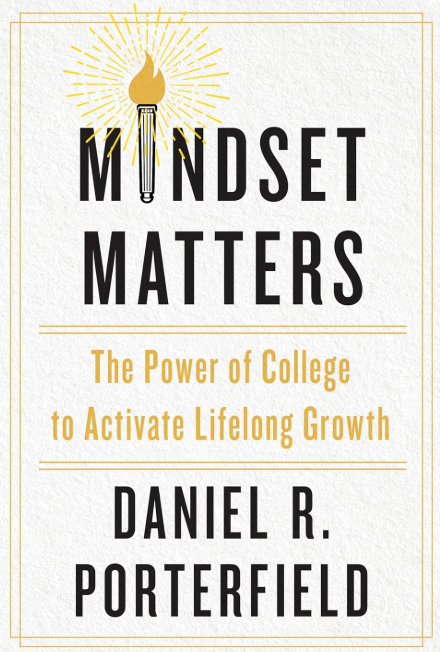
From the publisher: We live in an era of escalating, tech-fueled change. Our jobs and the skills we need to work and thrive are constantly evolving, and those who can’t keep up risk falling behind. That’s where college comes in. In Mindset Matters, Daniel R. Porterfield advances a powerful new argument about the value of residential undergraduate education and its role in developing growth mindsets among students.
The growth mindset, according to Porterfield, is the belief that we can enhance our core qualities or talents through our efforts, strategies, and education, and with assistance from others. People with growth mindsets have faith in self-improvement. They tend to be goal oriented and optimistic, confident that they can master new challenges because they’ve done so in the past. Feedback is their friend, errors their opportunities to begin again. For students like this, college is a multiyear process of self-creation and self-emergence, a becoming that unfolds because they are applying themselves in a place rich with stimulating people, happenings, resources, and ideas.
Principles of the Aspen Institute
As the Aspen Institute pursues its mission of promoting a free, just, and equitable society, our founding vision continues to animate us. Seven decades ago, the Institute’s founders were inspired by the unique challenges of their day: the Holocaust, a World War, and the enormous geopolitical uncertainty of the Cold War. Even as the challenges have changed, the essential elements of the founders’ vision have remained sharply relevant and provide the undergirding for the Principles that follow.
Our founding commitment to a humanistic outlook remains at our core and reflects our belief that the dignity of every person is paramount, that social progress is imperative and attainable, that we can achieve breakthroughs by engaging with humanity’s accumulated wisdom, and that the inner life and values-based leadership require nurturing. As we have gained new insights and understanding over the years, our conception of these points has changed. But our commitment to this humanistic outlook endures.
For more information visit the Aspen Institute’s website.