
Reasserting Potawatomi Presence Through Art
Join the Raclin Murphy Museum of Art to experience recordings from Indigenizing Museums, a two-day symposium amplifying the voices of Indigenous artists and curators, made possible by generous funding from the Terra Foundation for American Art. “Reasserting Potawatomi Presence in Michiana through Art,” the first of three panels, brings together artists David Martin, Christine Marie Rapp-Moreau, and Jason Wesaw for a conversation about their artistic practices and their approaches to asserting Indigenous identity through art, moderated by Zada Ballew '19, Chair of the Native American Alumni of Notre Dame.
Experience the Episode
Presented by The Raclin Murphy Museum of Art
Join the Raclin Murphy Museum of Art to experience recordings from Indigenizing Museums, a two-day symposium amplifying the voices of Indigenous artists and curators, made possible by generous funding from the Terra Foundation for American Art. “Reasserting Potawatomi Presence in Michiana through Art,” the first of three panels, brings together artists David Martin, Christine Marie Rapp-Moreau, and Jason Wesaw for a conversation about their artistic practices and their approaches to asserting Indigenous identity through art, moderated by Zada Ballew ’19, Chair of the Native American Alumni of Notre Dame.
Indigenous Voices is co-sponsored on ThinkND by the Initiative on Race and Resilience, the Raclin Murphy Museum of Art, the College of Arts & Letters Native American Initiatives, and the Native American Alumni of Notre Dame.
For more information visit the Raclin Murphy Museum of Art website.
MoreMeet the Faculty: Zada Ballew '19

Zada Ballew ’19 is an enrolled citizen of the Pokagon Band of Potawatomi Indians and a member of the bear clan. She earned her BA in Economics and Psychology from the University of Notre Dame and her MA and PhD in U.S. History from the University of Wisconsin–Madison. Her research explores the business history of her tribe from the fur trade in the seventeenth century to casinos today. Ballew’s work has been recognized by the Society for Historians of the Gilded Age and Progressive Era, the Business History Conference, and the University of Wisconsin–Madison. Her writing has appeared in the Journal of the Gilded Age and Progressive Era, the Poetry Foundation, and forthcoming in the Journal of the Illinois State Historical Society. In 2024, she was honored as one of ten inaugural Elouise Cobell Dissertation Writing-Year Fellows, an award which helped her complete her dissertation, “A Company of Kin: The Pokagon Band of Potawatomi Indians and the Business of Tribal Nationalism.”
In 2023-2024, Ballew served as the Historical Consultant and Cultural Liaison for the Native American Initiative of Notre Dame. In this role, she conducted “An Inquiry into Notre Dame’s History with Native Peoples,” starting before the University’s founding and continuing to the present. Through this work, she learned what many people have known all along: Indigenous peoples have profoundly shaped the history of Notre Dame in ways the broader community doesn’t quite yet know about. As a result of her work at Notre Dame, she was recognized as an Emerging Leader of the Pokagon Band of Potawatomi Indians by Mno-Bmadsen.
Beyond the academy, Ballew has served as the Chair of the Native American Alumni Board of Notre Dame, the Chair of the Governance Committee for the Better Way Foundation, and a Trustee for the Historical Society of Michigan Board of Trustees.
Meet the Artist: David Martin
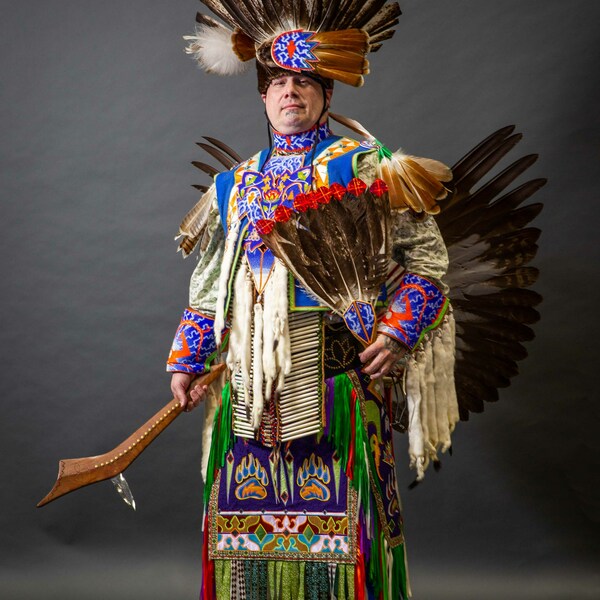
David Martin is a citizen of the Pokagon Band of Potawatomi Indians and has used his upbringing in a traditional native family to influence his art. Proudly self-trained, his artistic media include oil painting, beadwork, and tattoo art. Martin’s first venture into a career in art started in the late 1980’s doing beadwork and dance regalia for other Native American dancers. Beyond providing dancers with regalia, some of Martin’s completed beadwork pieces and other items have been displayed in the Indiana Statehouse in 2011, The South Bend Museum of Art in 2012 and 2018, and in the University of Notre Dame’s former Snite Museum of Art in 2019. In 1996, Martin started tattooing professionally in the Michiana area; in 2013, he opened Bicycle Tattoo in South Bend, the first tattoo shop to open within the city limits. Over the course of his career as a tattoo artist, Martin has won many national awards, including from one of the nation’s largest and most prestigious tattoo convention. Martin began his focus on oil painting in 2007; his first solo museum exhibition The Continuation of Potawatomi Culture: Paintings by David Martin opened at the South Bend Museum of Art in spring 2024. His commissioned work can be found in various places across Michigan and Indiana, and he has won awards at the Heard Museum in Phoenix, Arizona; at the Eiteljorg Museum of Western Art in Indianapolis, Indiana; at the Santa Fe Indian Market in Santa Fe, New Mexico; and at the inaugural Seneca Ohi:yo’ Indian Market in Salamanca, New York. Martin serves on the Indigenous Consultation Committee at Notre Dame’s Raclin Murphy Museum of Art, on the Board of Directors of the South Bend Museum of Art, and as the 2023-2024 Artist-In-Residence at Notre Dame’s Initiative on Race and Resilience.
Meet the Artist: Christine Marie Rapp-Morseau
Christine Marie Rapp-Morseau (Pokagon Band of Potawatomi) is well-known for her black ash basketry and porcupine quillwork. Christine’s Potawatomi name is Aba Kwesh (Cat Tail) and is Wolf Clan. Following in the footsteps of her grandmother, mother, and aunt, Christine has become a master black ash basket-maker, sharing and teaching her craft within the community. She is also an avid Potawatomi language learner and teacher. Her commitment to her Potawatomi identity is also evident in her leadership role on the Pokagon Band’s Traditions and Repatriations Committee, where she works to return Potawatomi ancestral remains to their rightful resting places. Christine’s vision for the future is a thriving community where Potawatomi cultural knowledge is carried on and passed down. She believes the tribe’s treasures lie in their community’s cultural bearers and traditional knowledge keepers, who have maintained the ways for future generations. Her efforts have helped ensure that the Pokagon Band’s language and culture will continue to flourish.
Meet the Artist: Jason Wesaw
Jason Wesaw (Pokagon Band of Potawatomi) is a multi-disciplinary artist, exhibiting works in various media including ceramics, textiles, works on paper, installations, and traditional cultural pieces. His projects relate stories about the Potawatomi people’s ancient and evolving connection to the Land, Sky, Water, and the Beyond. He balances being an artist with working in this Tribal community as a Peacemaker and by participating in traditional cultural ceremonies across the Great Lakes. Jason is a Potawatomi (Turtle Clan) and is raising his three children near the historic Pokagon Potawatomi settlement of Rush Lake in southwestern Michigan. His work is in the permanent collections of the Eiteljorg Museum, Indiana; Grand Valley State University, Michigan; the Newberry Library, Illinois; the Raclin Murphy Museum of Art, Indiana; the Indiana State Museum; and the Center for Native Futures, Illinois, among many others. Wesaw is a core artist for the upcoming Woven Being group exhibition at the Block Museum of Art at Northwestern University in Evanston, Illinois, and has a solo show opening at the Tube Factory in Indianapolis, Indiana in early 2025.
‘We survived’: David Martin, IRR artist-in-residence, celebrates Potawatomi resilience through dancing, painting

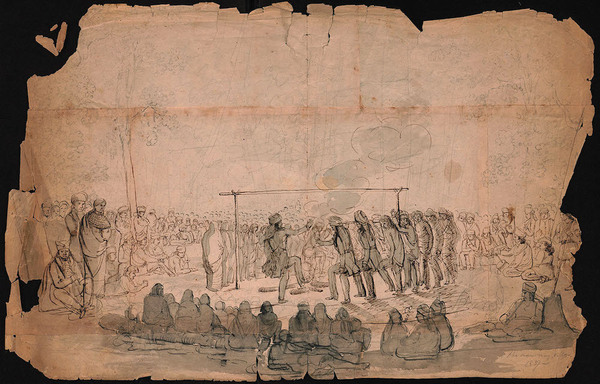
In 1837, when artist George Winter sketched a live Potawatomi dance social in northern Indiana, there was a consensus that Indigenous people would soon be extinct, said David Martin, a citizen of the Pokagon Band of Potawatomi, or Pokégnek Bodéwadmik.
“Native Americans as a whole, or the culture at least,” said Martin, the 2023-24 artist-in-residence with the Initiative on Race and Resilience in Notre Dame’s College of Arts & Letters. “In order for us to survive, we would have to become Americanized.”
One reason for the consensus was that U.S. officials were taking Indigenous children from their families and putting them in government- and church-run assimilation boarding schools.
Another was that U.S. soldiers were forcing Native Americans from their homelands in the East to land west of the Mississippi River.
“A lot of culture was lost,” Martin said. “Even in my lifetime, it was against the law for me to dance.”
‘We made it’
The Pokagon Band of Potawatomi ultimately proved the consensus wrong. Today, the federally recognized tribe has more than 6,000 citizens.
And more than 185 years after Winter sketched what some believed could be the last Potawatomi social in Indiana, Martin is helping to revitalize Potawatomi culture through the arts.
This fall, he organized and participated in two tribal dance and drum presentations on campus, one to celebrate Native American Heritage Month and another to mark the opening of the Raclin Murphy Museum of Art, where he is a member of the Indigenous Consultation Committee.
As IRR artist-in-residence, Martin also visits classes, opens his studio to students, supports the Native American Student Association, provides perspective as a working artist, and shares his culture, including through his paintings.
In his Riley Hall studio on campus, Martin works on his passion project — a 12-foot-by-6-foot oil on canvas that modernizes Winter’s sparse 1837 pencil drawing. One update includes changing Winter’s depiction of Indigenous people sitting on a log to tribal leaders relaxing in lawn chairs.
“Just to show that we survived. We made it,” he said. “We have issues that all minorities have, but we’re definitely on the upswing, and I want to represent that in this painting.”
Martin also updates tradition in his beadwork, other paintings, and tattoos.
“That’s my general philosophy. If you’re a surviving, thriving, growing culture, you have to evolve to keep from becoming stagnant,” he said.
Understanding the past, though, is vital. And Martin is an educational resource on campus.
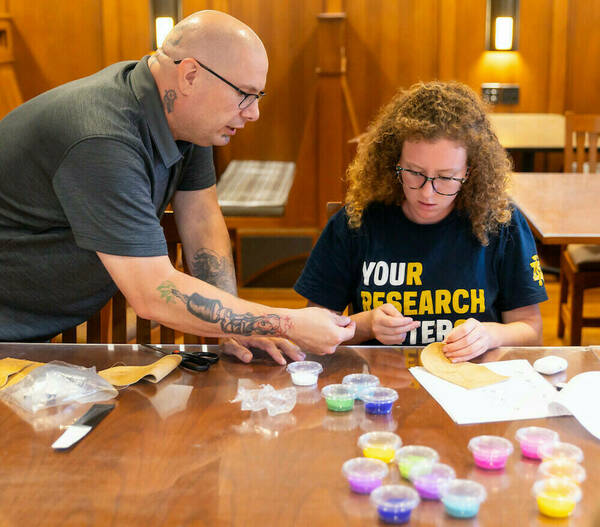
During a recent class visit, he noted to students that a novel’s period drawing of an Indigenous village in Chicago incorrectly included tepees.
“That’s not what it looked like in real life. We had wigwams and permanent log structures,” said Martin, whose Potawatomi name is Mamanjigosid Minosino.
Students sometimes ask him about a variety of topics, including Native American history.
“They can tell maybe they were taught something wrong, and they’re looking to correct it on their own accord,” Martin said. “If they ask me, I fill in the gaps. While I’m here, I’m just trying to humanize Native Americans to students and faculty who are not Native American.”
‘This is what we do’
Art has been important to Martin since his childhood — even before he recognized that beadwork and making Native American dance regalia were creative pursuits.
“Back then, almost everybody — you and your family — worked on outfits together,” he said. “And I thought, ‘This is what we do.’ It wasn’t until later in life I realized, ‘Oh yes, this is an art.’”
Martin’s work has earned acclaim in multiple mediums. His beadwork has been showcased at the Indiana Statehouse, South Bend Museum of Art, and the Snite Museum of Art, and his tattoos have won numerous national awards.
Martin learned to tattoo nearly 30 years ago; for the trained illustrator, it was a way to both support his family and remain involved with art.
“Our drum (drumming and dancing group) traveled a lot back then, in Oklahoma and Florida, so any time we went to a powwow, I tattooed Natives all night Saturday in my hotel room,” he said.
The former owner of Bicycle Tattoo & Piercing in South Bend also uses his talents for social good. While Martin hasn’t experienced discrimination directly, he said everyone around him has — including his children, who are Potawatomi and African American. In 2017, when white supremacists marched in Virginia, he and colleagues offered to cover up racist tattoos for free.
“It was the one thing we could do that was real and that could make an actual impact,” he said. “I think we really changed some lives.”
‘Dancing helped bring us back’
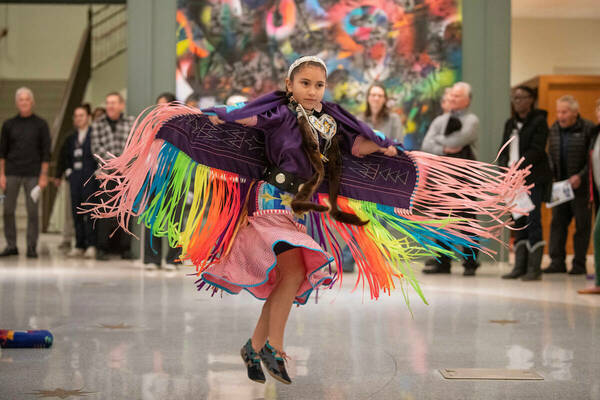
These days, Martin befriends people with opposing viewpoints, including those who argue that Native American mascots aren’t offensive. Martin even invited one such tattoo client to a powwow.
“It’s easier to have a logical, friendly discourse if you’re friends first. It might be as simple as sharing food,” he said. “And now that we’re friends, he’s probably not comfortable calling my mom a redskin.”
Martin, who has a solo show, The Continuation Of The Potawatomi Culture, through March 24, 2024, at the South Bend Museum of Art, is continuing to work on his remake of Winter’s sketch of the Potawatomi dance.
“Winter recorded us dancing, thinking it was the end, that we were going extinct,” Martin said. “But over the years, dancing is almost universally what has helped bring Indigenous people back to their culture. I want to show that.”
This article was written by Beth Staples and originally published on February 28, 2024 on the website of the College of Arts & Letters.
A Song for Everything
For more information on the art, dance, and culture of the Pokagon Band of the Potawatomi and to view the documentary A Song for Everything, please visit the Band’s Center of History & Culture website.