

Native American Dance and Drum Performance
In honor and celebration of Native American Heritage Month 2023, The Notre Dame Initiative on Race and Resilience in collaboration with artist-in-residence, David Martin, hosted a Native American Dance and Drum performance. The program featured songs and dance styles of Potawatomi and other Great Lakes region tribes in the spirit of sharing culture, celebrating heritage, and strengthening connections between the Pokagon Band of Potawatomi and the University of Notre Dame.
Experience the Event
Presented by The Initiative on Race and Resilience
Tuesday, November 26, 2024 12:00 pm

In honor and celebration of Native American Heritage Month, Initiative on Race and Resilience in collaboration with artist-in-residence, David Martin, hosted a Native American Dance and Drum performance on November 8, 2023.
The program featured songs and dance styles of Potawatomi and other Great Lakes region tribes in the spirit of sharing culture, celebrating heritage, and strengthening connections between the Pokagon Band of Potawatomi and the University of Notre Dame. This event was the first time in nearly 30 years that Notre Dame has hosted a large Indigenous dance and drum event on campus.


The Dance and Drum Performance was cosponsored by the Institute for Social Concerns, the Office of the Provost, Academic Diversity and Inclusion, the Department of Sociology, the Center for the Study of Languages and Cultures, the Department of Africana Studies, ThinkND, the Klau Institute for Civil and Human Rights, and the Native American Initiative. All photos by Barbara Johson/University of Notre Dame.
For more information visit the event website.
MoreMeet the Artist: David Martin

David Martin is a citizen of the Pokagon Band of Potawatomi Indians and used his upbringing in a traditional native family to influence his art. Proudly self-trained, his artistic mediums include oil painting, beadwork, and tattoo art. He is an independent local artist with current appointments serving as a member of the Indigenous Consultation Committee at Notre Dame’s Raclin Murphy Museum of Art and as the 2023-24 Artist-in-Residence at Notre Dame’s Initiative on Race and Resilience.
Martin’s first venture into a career in art started in the late 1980s doing beadwork and dance regalia for other Native American dancers. When working on traditional cultural items for dance, Martin focuses on acknowledging motifs and designs of the past while putting a modern twist on regalia in either materials or artistic execution. Beyond providing dancers with regalia, some of Martin’s complete beadwork pieces and other items have been displayed in the Indiana Statehouse (2011), the South Bend Museum of Art (2012, 2018), and the University of Notre Dame’s Snite Museum of Art (2019).
In 1996 David Martin started tattooing professionally in the Michiana area and in 2013 opened Bicycle Tattoo in Downtown South Bend, the first tattoo shop to open within the city limits. Born from Martin’s focus and skill with photo realistic tattooing, Bicycle Tattoo was also the first to have a hard focus on custom art. Over the course of his career as a tattoo artist, Martin has won many national awards including some from one of the nation's largest and most prestigious tattoo conventions, the Motor City Tattoo Expo. His awards have included: Most Realistic Tattoo (2006), Best Full Back Tattoo (2007, 2008,2015), and Best Full Arm Sleeve (2008). On top of many other tattoo awards Martin has also won Best of Show at the Harvest Moon Tattoo Exp (2005) and Best Large Black and Grey Tattoo at the St. Louis Tattoo Expo (2010). Beyond his commissioned pieces, Martin and his work at Bicycle Tattoo was featured in a short documentary by the Grotto Network in 2017 in response to his pledge to cover up any racist tattoos for free to individuals following the events in Charlottesville, VA.
Martin began his current artistic focus – oil painting – in 2007. His commissioned work can be found in various places across Michigan and Indiana, including at the South Bend, IN, New Buffalo, MI, Dowagiac, MI and Hartford, MI locations of the Four Winds Casinos. Most recently Martin completed a commission for the Center for Social Concerns’s Arts of Dignity series at the University of Notre Dame and started submitting work to Native Art markets. His 2023 submissions alone have won various awards including: ‘Honorable Mention’ for the oil painting “Michigan Snake Dance” at the Heard Museum in Phoenix, AZ and three awards at the Eiteljorg Museum of Western Art in Indianapolis, IN including ‘Third Place’ for “Red Deer, Michigan Wetland” and ‘First Place’ and ‘Best of Show’ for the oil painting “Portrait of Clarence White.” Currently Martin is preparing for a solo show of oil paintings at the South Bend Museum of Art in January of 2024.
His Potawatomi name, Mamanjigosid Minosino, translates to “Lame Warrior” and was given to him as a teenager while recovering from being hit by a car on his bicycle. Martin’s distinctive style is influenced by the traditional aesthetics of the indigenous people of the Great Lakes as well as his personal love of science fiction and fantasy storytelling. In addition to his art, David is a husband, father, pow-wow singer, dancer, entrepreneur, and paintball enthusiast.
What is a land acknowledgement?
We acknowledge our presence on the traditional homelands of Native peoples including the Haudenosauneega, Miami, Peoria, and particularly the Pokégnek Bodéwadmik / Pokagon Potawatomi, who have been using this land for education for hundreds of years and continue to do so. We know land acknowledgments are always a work in progress; we last updated this on May 14, 2023.
The College of Arts & Letters Native American Initiatives provides information on land acknowledgements.
What are land acknowledgements and why do they matter?
Guide to Indigenous Land and Territorial Acknowledgements for Cultural Institutions
Other institutions of higher education have already adopted a formal Land Acknowledgement. These include (but are not limited to):
- Harvard University Department of Social and Behavioral Sciences
- Columbia University Native American Council
- Stanford University
- Northwestern University
- New York University
- The Ohio State University
- University of Minnesota
- University of Illinois at Urbana Champaign
- University of Illinois at Chicago
- University of Illinois at Springfield
- University of Wisconsin – Madison School of Education
- Michigan State University
- Syracuse University
- Colorado State University
- Lawrence University
- University of North Carolina at Greensboro
- Emerson College
- Goshen College
- Seattle Central College
Native American Alumni of Notre Dame
The Native American Alumni of Notre Dame (NAA of ND) is an affinity group of the Notre Dame Alumni Association serving Notre Dame alumni, students and faculty of Native American Heritage. The NAA of ND was established in the fall of 2003. Our mission is to develop, maintain and celebrate our tribal cultures and to enrich the experience of the Notre Dame family. Your support, and participation in NAA of ND activities, will help to increase the visibility of Native Americans in the Notre Dame community. Your involvement will also help to highlight the crucial role that the Native American community has had in the history of the University of Notre Dame. By working together, we can help to expand Notre Dame’s growing understanding of the history of Native Americans and Notre Dame.
For more information about the Native American Alumni of Notre Dame, our work and how you can get involved, please visit their website.
Fighting to Build on Tradition
When Dot Teso, the president of St. Michael Indian School on the Navajo Nation, wanted to expand her campus, she turned to Notre Dame’s School of Architecture. After years of partnering with Notre Dame’s ACE program and American Indian Catholic Schools Network, she had witnessed Notre Dame’s commitment to Catholic education, and she was confident the architecture faculty and students would bring the same commitment to design. She, along with Deswood Etsitty ’93, invited a group of undergraduates to the campus in Arizona to learn about Navajo culture, to meet the community members, and to start designing the campus’ first new building, a gym where the community can congregate. The students are trained in Classicism and were eager to incorporate Navajo art, culture and values into their designs. Several of those designs will serve as the basis of the school’s upcoming construction.
To read the full story, please visit the What Would You Fight For? website.
Bowl with Spirit Face Interior
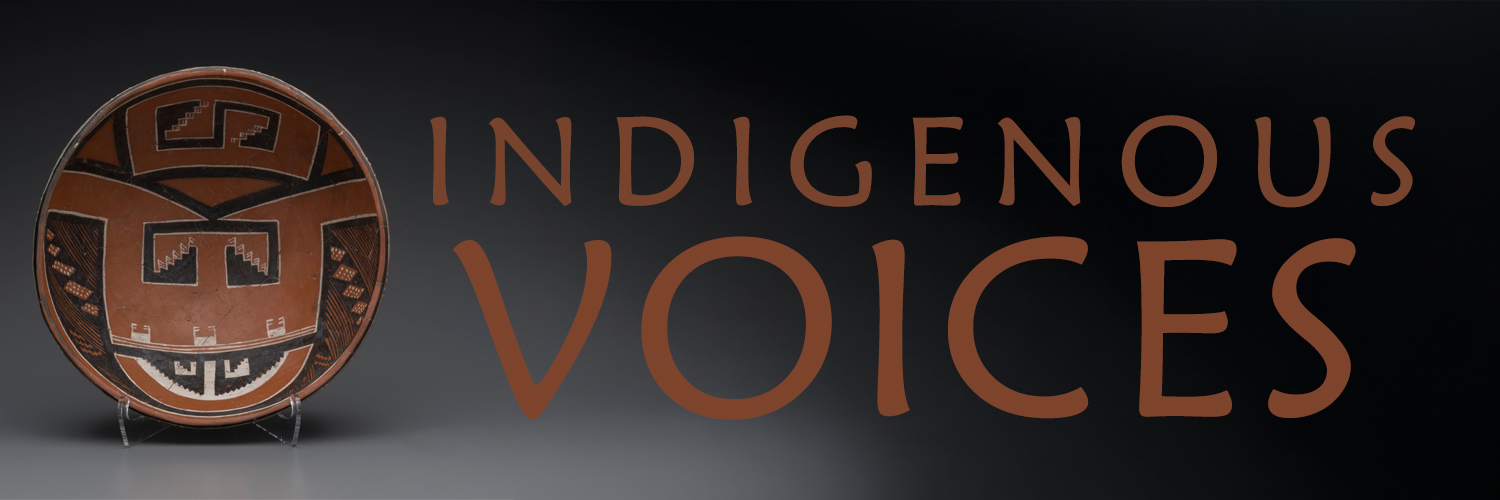
The image of this slipped and painted ceramic bowl by an unrecorded Ancestral Puebloan artist from the permanent collection of the Raclin Murphy Museum of Art was used as the basis of the graphics created for Indigenous Voices. To learn more about the bowl please click here. To see more from the Indigenous Art of the Americas collection, please visit the Raclin Murphy Museum of Art website.
