
Human Dignity
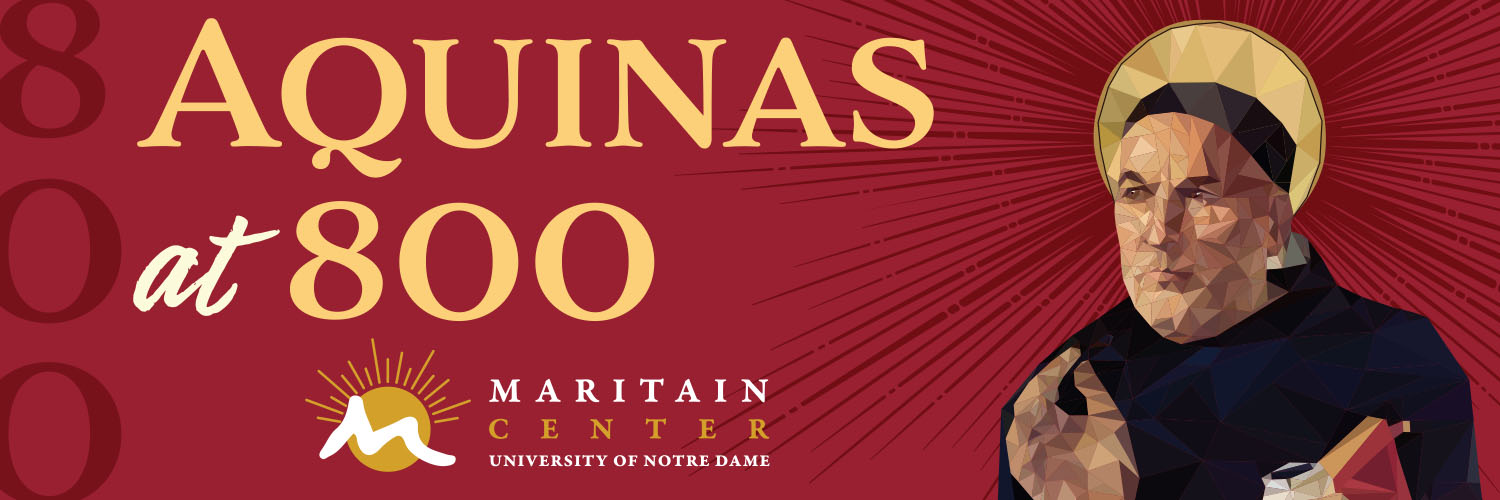
How can Thomas Aquinas continue to influence the way we think about human dignity, even today? In a world more deeply in need than ever, contemplate Aquinas’ thoughts on the connection between human dignity, compassion, disabilities, and the sacraments.
Experience the Event
How can Thomas Aquinas continue to influence the way we think about human dignity, even today? In a world more deeply in need than ever, contemplate Aquinas’ thoughts on the connection between human dignity, compassion, disabilities, and the sacraments.
The comprehensive and systematic character of Thomas Aquinas’ thought has for centuries informed inquiry into questions of human dignity, freedom, economic development, work, poverty, the environment, and other issues of global significance. Celebrate the 800th anniversary of the birth of Thomas Aquinas, exploring the ongoing importance of his thought to contemporary cultural, philosophical, and theological discussions. In gathering many of the most accomplished contemporary scholars of Aquinas’ thought from throughout the world working on themes in Ethics, Metaphysics, Epistemology, Anthropology, Political Theory, Christology, Trinitarian Theology, Sacramental Theology and Ecclesiology, among others, this series promotes fruitful interchange of diverse perspectives on the importance of Aquinas in the world today.
Featured Speakers:
- Moderator: Carlos A. Casanova, Visiting Professor at the Hamilton Center, University of Florida
- John O’Callaghan ’86 MS, ’96 Ph.D., Associate Professor of Philosophy, University of Notre Dame
- Michael Waddell, McMahon Aquinas Chair in Philosophy, Saint Mary’s College
- David Lantigua ’12 Ph.D., William W. and Anna Jean Cushwa Co-Director of the Cushwa Center for the Study of American Catholicism, Associate Professor of Theology, University of Notre Dame
Meet the Speaker: Carlos A. Casanova

A native of Venezuela, Carlos Casanova holds a law degree from the Catholic University Andrés Bello and a Ph.D. in philosophy from the University of Navarre, Spain. He was until recently a professor at the School of Law of the Pontifical Catholic University of Chile. He is currently a lecturer at the Hamilton School of Classic and Civic Education at the University of Florida. Prior to this, Professor Casanova served as an attorney for the Office of the Attorney General of Venezuela and for the Venezuelan Congress, and as an assistant to a Justice of the Venezuelan Supreme Court. He has also served as professor at Santo Tomás de Chile, professor and director of the International Academy of Philosophy at the Pontifical Catholic University of Chile, and professor and chair of the graduate program in philosophy at the Simón Bolívar.
Professor Casanova has been a visiting scholar at Boston University and a senior research associate at the Jacques Maritain Center, University of Notre Dame, where he worked with Ralph McInerny. Professor Casanova’s work focuses on political and social philosophy, ethics, metaphysics, and classical Greek philosophy. His scholarly competence also includes philosophy of science, epistemology, philosophy of mind, medieval philosophy, and contemporary European philosophy. He has published nine books and numerous scholarly papers.
Currently Casaonova is preparing a manuscript for CUA Press on the origin of the two main traditions of subjective rights. He is also giving the final touches to a paper on Christianity and the freedom of religion. A shorter version of it is now published in Polish and in Poland. In addition, he is researching the connection between the Marxist tradition and hope. He is currently working to publish some of his previous work in English in the form of books.
Meet the Faculty: John O’Callaghan ’86 MS, ’96 Ph.D.

John O’Callaghan ’86 MS, ’96 Ph.D. is an associate professor of philosophy at the University of Notre Dame.
O’Callaghan is a permanent member of the Pontifical Academy of St. Thomas Aquinas. Established in 1879 by Pope Leo XIII to promote the study of the thought of St. Thomas and to bring it into engagement with contemporary culture, the Pontifical Academy of St. Thomas has 50 members. O’Callaghan, an associate professor of philosophy at Notre Dame whose scholarship concerns medieval philosophy and Thomistic metaphysics, is one of four academy members from the United States.
A member of the Notre Dame faculty since 2003, O’Callaghan was graduated from St. Norbert College in 1984 and earned a master’s degree in mathematics from Notre Dame in 1986. He worked as an engineer in Boston for two years before returning to Notre Dame, where he earned a doctoral degree in philosophy in 1996. Before joining the Notre Dame faculty, he taught philosophy at Creighton University and the University of Portland. In 2006, he was appointed director of the Jacques Maritain Center.
Meet the Speaker: Michael Waddell
The current holder of the Edna and George McMahon Aquinas Chair in Philosophy is Michael M. Waddell, Ph.D.

Dr. Waddell received his Ph.D. in Medieval Philosophy and his Master of Medieval Studies from the University of Notre Dame after having been graduated summa cum laude from Cornell College with a Bachelor of Arts in Religion and History. Before coming to Saint Mary’s, he taught at Villanova University and Augustana University. Dr. Waddell has published articles in The Thomist, International Philosophical Quarterly, Nova et Vetera, Sapientia, Tópicos, The Lyceum, The Saint Anselm Journal, and Miscellanea Mediaevalia, and has edited a collection of essays entitled Restoring Nature: Essays in Thomistic Philosophy and Theology. He has delivered lectures at the University of Oxford, the University of Cambridge, St. Anselm College, and the University of Mississippi, read solicited papers for the Society for Medieval and Renaissance Philosophy and the Institute for Saint Anselm Studies, and presented his work at meetings of the American Catholic Philosophical Association, the American Philosophical Association, the Société Internationale pour l’Étude de la Philosophie Médiévale, the Patristic, Medieval and Renaissance Studies Conference, and the International Congress for Medieval Studies.
Dr. Waddell’s scholarly interests include Thomas Aquinas’s metaphysics (especially his doctrine of transcendental truth, goodness and beauty), his account of the human soul and of the human person more holistically understood, and the ways in which these two areas of Thomas’s thought—viz., his metaphysics and his anthropology—are interconnected. His current work examines the writings of Thomas Aquinas and the broader Catholic tradition for resources to advance our understanding and our responses to disabilities, including especially autism spectrum disorder.
Meet the Faculty: David Lantigua ’12 Ph.D.
Born of Latino immigrants, David Lantigua ’12 Ph.D. graduated with a Ph.D. in Theology from the University of Notre Dame. He taught previously at The Catholic University of America, and has been a graduate fellow of the Notre Dame Institute for Advanced Study and past recipient of the Louisville Institute Sabbatical Research Grant. He previously served as Co-Director of the Catholic Social Tradition minor in the Institute for Social Concerns. He is currently the William W. and Anna Jean Cushwa Co-Director of the Cushwa Center for the Study of American Catholicism.

Prof. Lantigua teaches undergraduate courses on God and Slavery in the Americas and Catholic Social Teaching. He has served on exam and dissertation committees for graduate students in the areas of Moral Theology, History of Christianity, World Religions and World Church, and the Departments of Political Science and History. Prof. Lantigua is currently writing a monograph on the Latin American theological and cultural dimensions of Pope Francis’s social teachings and its implications for global Catholicism in the twenty-first century.
Aside from spending time in the Florida sunshine with family, he enjoys playing fútbol with his children and cheering for the US and Paraguayan (and Argentine) national teams.