The Bible in Its Traditions

Do you desire a deeper encounter with the Word? Engage with Father Olivier-Thomas Venard, OP as he reanimates the ancient scriptures. Hear how the cross radiates light and how medieval poetry anchors modern reason. Enrich your spiritual life by listening to this vibrant dialogue on the enduring, luminous vitality of faith.

RECORDING COMING SOON!

Want more Everyday Holiness? Click here to check out the full series.
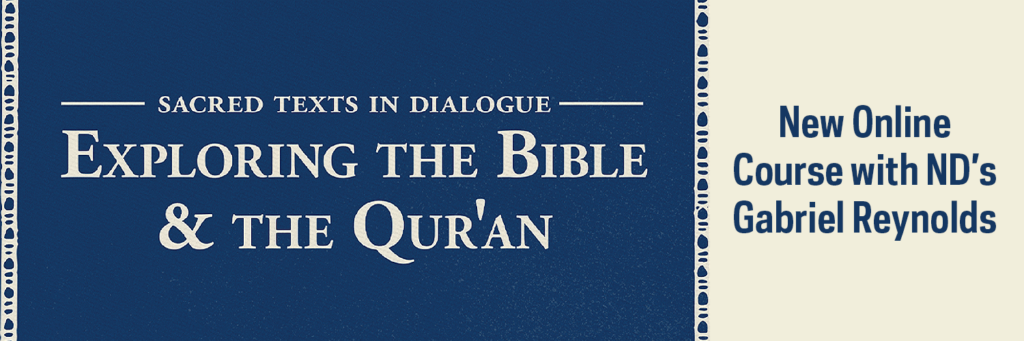

Interested in going even deeper on this topic? Join Professor Said Reynolds for his new online course Sacred Texts in Dialogue, offered through the Coursera platform, to explore the common points, and stark differences, between the Bible and the Qur’an. The course consists of six modules and assumes no previous knowledge of the two books. For more information, click here.


The Vocation of Reason: From Secular Literature to the Dominican Ideal
Intellectual formation is the bedrock of theological contribution. Father Venard’s journey began at the École Normale Supérieure before he transitioned to the Order of Preachers. Influenced by his father’s witness to the intelligibility of faith and traditional Thomistic metaphysics, he embraced the Dominican ideal of Contemplata aliis tradere—handing on the fruits of contemplation. This programming fused secular literary excellence with a religious vocation, seeking truth within the sweetness of friendship. For Venard, the Dominican life provided the architecture to treat study and poverty as instruments of preaching, ensuring the proclamation of the Word remained rigorous.
This vocational synthesis of reason and faith finds its most articulate expression in Venard’s treatment of the scriptural and Thomistic corpora as vibrant literary artifacts.
The Poetics of Aquinas and the Language of the Ineffable
Viewing theological monuments like the Summa Theologiae as literary artifacts allows us to bridge medieval certainty and modern skepticism. Influenced by Erwin Panofsky’s analysis of the structural parallels between Gothic architecture and scholasticism, Venard argues that in the Summa, God (Deus) is the active Subject of thousands of verbs in the present indicative. This contrasts with modern poets like Yves Bonnefoy, who struggle with a “worn out” vocabulary. Venard’s trilogy seeks to restore confidence in language:
  • Volume 1: Literature and Theology – A redescription of the Summa as a literary masterpiece in dialogue with contemporary theory.
  • Volume 2: Metaphysics and Language – An argument that metaphysics requires a theological foundation to survive deconstruction.
  • Volume 3: The Praxis of Scripture – An exploration of how liturgical rites refound our capacity to speak the truth.
This linguistic architecture finds its ultimate cornerstone in the visceral, historical reality of the Cross.
The Splendor in the Horror: Reimagining the Crucifixion
Reclaiming ancient perspectives on the Cross balances the modern emphasis on suffering with the classical emphasis on victory. In his project The Horror and the Splendor, commissioned by Muslim scholar Husnija Mahmutcevic at the Shalom Hartman Institute, Venard explores parodic exaltation. The Latin Levatus est in cruce—elevated on the cross—reveals how Roman mockery unintentionally unveiled divine kingship. Challenging the Black Plague era’s focus on agony, Venard advocates for the luminous cross of the early Church: a cosmic source of light and the key to understanding human existence.
The theological radiance of the Cross necessitates a scholarly infrastructure capable of sustaining the vibrant liquidity of the sacred text.  
The Polyphonic Word: The École Biblique and the Liquidity of Scripture
Historical-critical scholarship maintains the vibrancy of faith by grounding it in rigorous inquiry. The École Biblique’s Bible in Its Traditions project moves beyond a wild goose chase for a single original text, embracing the liquidity and polyphony of versions like the Septuagint and Vulgate. Drawing from Psalm 62:11 (“God spoke once… I understood two things”), the project celebrates these irreducible traditions. Venard defines scripture as both a book and a recipe, a living reality that requires a flesh-and-blood community and liturgical enactment to be fully realized.
The polyphonic nature of the Word invites a profound re-examination of the shared heritage between the Church and the Synagogue.
Shared Roots: Friendship and the Future of Theology
Interfaith friendship is a primary column for theological renewal. Venard posits that the New Testament is Jewish Second Temple literature, representing a possible Jewish synthesis from a period of immense religious diversity. While Christians read the Old Testament, Jews read the Tanakh—distinct organizations of shared texts. By acknowledging these differences, we find a tradition united by the Torah but expressed through different eschatological lenses. This collaboration with Jewish scholars allows Christians to better understand the shared roots that inform their own Messianic recognition.

  • What is the liquidity of scripture?
    It is the recognition that the Bible is not a static, printed object but a living reality—both a book and a recipe—that must be enacted through the ritual practices and liturgical life of a flesh-and-blood community.
  • How does parodic exaltation change our view of the Crucifixion?
    It demonstrates that the Roman soldiers’ mockery—crowning Jesus and elevating him—unintentionally revealed his true kingship, showing splendor shining through the horror.
  • Why is Aquinas considered a poet in this context?
    Beyond his clear reasoning, Aquinas utilized the rhythms of Latin and the status of God as the active Subject of his syntax to express a heartfelt passion for the divine.
  • What is the mission of the Bible in Its Traditions project?
    It shifts scholarship from seeking one original text to presenting a polyphony of traditional versions (Hebrew, Greek, Latin) that have been used and transmitted by faith communities.
  • How does Father Venard define the relationship between Christianity and Judaism?
    He views them as two traditions emerging from the diverse Judaism of the Second Temple period, with the New Testament serving as a possible Jewish reading centered on the Messiah.

  • “Looking for truth in the sweetness of friendship. That is something all in all that I’ve been experimenting in our order.” — Father Olivier-Thomas Venard
  • “The coincidence of horror and splendor was not only an interpretive movement, but even witnesses to the crucifixion could have started that coincidence.” — Father Olivier-Thomas Venard
  • “The word of God is not one single text, but is a polyphony of texts, of versions.” — Father Olivier-Thomas Venard
  • “Scripture is not firstly a book. I would say it’s like it’s both a book and a recipe. You have to do something about scripture while celebrating sacraments, celebrating liturgy.” — Father Olivier-Thomas Venard
  • “The Christian reading continues kind of apocalyptic eschatological Pharisaic reading of scriptures… that synthesis is at the time a possible Jewish synthesis.” — Father Olivier-Thomas Venard

About the Podcast:

Minding Scripture is a podcast where divine word and human reason meet. We explore questions that believers and skeptics alike ask about the Bible and the Qur’an. In their conversations on scripture and its interpretations, Francesca Murphy, Gabriel Reynolds, Mun’im Sirry, Tzvi Novick, and guest speakers reflect the deep intellectual diversity of Judaism, Christianity, and Islam. In a world marked by irrational discourse about religion, this podcast seeks to demonstrate that faith sharpens and quickens the ability to reason in friendship.

Learn More

July 6, 2020

Religion and PhilosophyUniversity of Notre DameMinding Scripture PodcastChristianityFrancesca MurphyGabriel ReynoldsIslamJudaismReligion

More Like This

Related Posts

Let your curiosity roam! If you enjoyed the insights here, we think you might enjoy discovering the following publications.
Stay In Touch

Subscribe to our Newsletter


To receive the latest and featured content published to ThinkND, please provide your name and email. Free and open to all.

Name
This field is hidden when viewing the form
What interests you?
Select your topics, and we'll curate relevant updates for your inbox.
Affiliation
Secret Link