
Dante Among Theologians

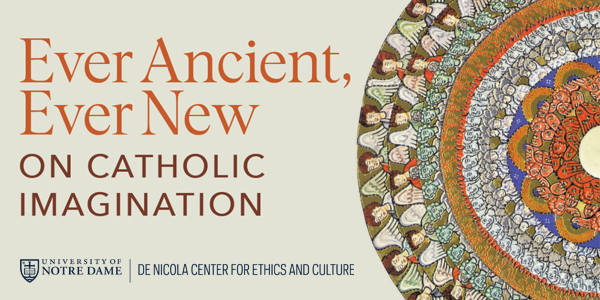
Step into the celestial rose of the “Dante Among Theologians” project, an international collaboration that invites you to rediscover the poet’s vision not merely as verse, but as a living source of spiritual wisdom and theological insight. This session from the de Nicola Center’s 2024 Fall Conference on the Catholic Imagination introduces the “Dante Among Theologians” initiative.

“Dante Among Theologians” brings diverse approaches to Dante’s works into conversation with the goal of examining the theological dimensions of the poet’s work in relation to its historical contexts and its reception across time.

The project seeks to integrate disparate disciplines through three primary research strands:

  • Dante Among Contemporaries: Situating the poet alongside medieval giants like Thomas Aquinas, Bonaventure, and Bernard of Clairvaux.
  • Theological Reception: Analyzing 700 years of how theologians—from Scholastics to modern popes—have interpreted his work.
  • The Poet-Theologian: Examining Dante as a figure whose theology is inseparable from his poetics.

This cross-institutional collaboration overcomes the fragmentation of modern academia. By uniting historians, theologians, and literary scholars in a common project, “Dante Among Theologians” recreates a vibrant interdisciplinary space that reflects the holistic nature of the poet’s own worldview.

The “Dante Among Theologians” project is led by the de Nicola Center for Ethics and Culture and the Devers Program in Dante Studies, operating under the aegis of the Notre Dame Global Catholic Research Initiative.

Beyond the Literary: Dante as a Systematic Thinker
In contemporary scholarship, a critical shift is underway: moving beyond treating Dante Alighieri merely as a literary giant and recognizing him as a formidable theologian. This transition is essential because it acknowledges that the Commedia is not just an aesthetic achievement, but a sophisticated theological architecture designed to facilitate a transformative conversion. By treating Dante as a systematic thinker, we recognize his poem as a “living source” capable of drawing the reader into the mystery of the beatific vision. 

Case Study: The Retrieval of Pierre Mandonnet
A centerpiece of this initiative is George Corbett’s recovery of Pierre Mandonnet’s 1935 work, Dante the Theologian. Mandonnet, a Dominican master of the historical method, offered a rigorous Thomistic reading of Dante that was largely eclipsed by mid-20th-century “literalist” scholars like Charles Singleton. Mandonnet’s thesis was a necessary reaction to the secularizing trends of the 19th century, such as the Risorgimento, which sought to claim Dante as a purely political or romantic figure, divorced from the Church.

The broader scholarly consequence of this retrieval is the challenge it poses to the “Truth Game” of modern literalism. For Mandonnet, the appropriate hermeneutic is “indirect literal signification.” Much like how scripture speaks of the “arm of God” to signify operative power, the literal narrative of the Commedia is an instrument—a “Beautiful Lie”—that hides and reveals profound doctrine. Under this framework, Beatrice is not merely the historical Bice Portinari, but a purely symbolic figure representing Christian Theology. Recovering such “abandoned” theses allows us to question the absolute legitimacy of current scholarly orthodoxies.

Theological Poetics and the Mystery of Salvation
Vittorio Montemaggi extends this inquiry by exploring the Gates of Hell (Inferno 3) through the lens of “Universal Salvation.” This research engages with contemporary theological “foils,” such as David Bentley Hart, who critiques Dante’s God as vindictive and his Hell as infinitely disproportionate. In contrast, Montemaggi utilizes the perspective of Denys Turner, who views Hell not as a divinely imposed sentence, but as a “story of sin” told by those who refuse to repent, clinging to their self-centered narratives over the story of Divine Love.

This shift moves the reader from a descriptive view of Hell—where judgment is a static, external sentence—to a transformative view. The poem becomes an invitation to participate in the mystery of mercy. This is evidenced by the figure of Virgil, who may not be a fixed entity but a character “developing” through his journey in the realm of salvation. By highlighting these nuances, the project suggests that the poem’s theological value lies in its capacity to engage the imagination as a supplement to scripture, offering a motive for transformation.


  1. What is the primary goal of the “Dante Among Theologians” project? The project aims to foster international dialogue that integrates the study of Dante across theology, literature, and history. It seeks to move beyond academic silos to treat Dante’s work as a living source of spiritual wisdom rather than merely an object of historical study.
  1. What is the significance of the “allegory of the poets” vs. the “allegory of the theologians”? While some 20th-century scholars argued the Commedia must be read as history (theology), this project revisits the “allegory of the poets.” This means the literal story is a “Beautiful Lie”—an instrument used to manifest deeper moral and theological truths, much like symbolic language in scripture.
  1. Is Beatrice a real historical woman or a symbol? While modern scholarship often identifies her as Bice Portinari, the project recovers Pierre Mandonnet’s 1935 “abandoned thesis.” Mandonnet argued that Beatrice is a purely symbolic figure representing Christian Theology, a perspective originally intended to protect Dante’s religious legacy from 19th-century secularization.
  1. Can there be hope in Dante’s Hell? Despite the gate’s famous warning to “abandon all hope,” the project highlights instances where the fixed nature of Hell is subverted. A key example is the salvation of Emperor Trajan through the prayers of Pope Gregory, suggesting that “praying in hope for the hope of others” is a central, redemptive theme.
  1. How does Dante view the relationship between human judgment and Divine Mercy? Dante emphasizes that human beings cannot fully see into Divine Judgment. The project suggests the poem is not about condemnation but is a “motive for transformation.” This is seen in characters like Virgil, who appears to develop and learn—such as how to smile—while journeying through the realms of salvation.

  • “His poetry is in my bones and imprinted indelibly upon my heart… a living source of beauty, wisdom, and spiritual insight.” — Jennifer Newsome Martin
  • “Dante is a theologian of extraordinary learning, there being no doctrine in Lady Philosophy’s bosom of which he is ignorant.” — George Corbett (quoting the ancient epitaph of Giovanni del Virgilio)
  • “The literal sense [is] understood nonetheless as a beautiful lie, and to the doctrine especially moral and theological which it covers and hides.” — George Corbett (summarizing Mandonnet’s hermeneutic)
  •  “The Comedy exceeds magisterial theological production… it offers a motive for transformation that no theological treatise can provide.” — Vittorio Montemaggi (referencing Cyril O’Regan)
  • “To read the Comedy as a form of judgment in the sense of condemnation would be to read it at odds with a fundamental aspect of Christian teaching.” — Vittorio Montemaggi

Art and HistoryReligion and PhilosophyUniversity of Notre Damede Nicola Center for Ethics and Culture

More Like This

Related Posts

Let your curiosity roam! If you enjoyed the insights here, we think you might enjoy discovering the following publications.

Stay In Touch

Subscribe to our Newsletter


To receive the latest and featured content published to ThinkND, please provide your name and email. Free and open to all.

Name
This field is hidden when viewing the form
What interests you?
Select your topics, and we'll curate relevant updates for your inbox.
Affiliation
Secret Link