

Black Excellence, HBCUs & American Democracy

Join us for a discussion with Deondra Rose about her recent book The Power of Black Excellence: HBCUs and the Fight for American Democracy, and lessons we can learn from HBCUs about cultivating character for the common good.
Experience the Event
Monday, March 31, 2025 12:00 pm

Join us for a discussion with Deondra Rose about her recent book The Power of Black Excellence: HBCUs and the Fight for American Democracy, and lessons we can learn from HBCUs about cultivating character for the common good.
Learn more at the Virtues & Vocations website. Register to receive emails about Virtues & Vocations below.
MoreMeet the Speaker: Deondra Rose
Deondra Rose is the Kevin D. Gorter Associate Professor at the Sanford School of Public Policy with secondary appointments in the Department of Political Science and the Department of History. Her research focuses on U.S. higher education policy, political behavior, American political development, and the politics of inequality, particularly in relation to gender, race, and socioeconomic status.
Rose’s new book, The Power of Black Excellence: HBCUs and the Fight for American Democracy (Oxford University Press, 2024), examines the crucial role that historically Black colleges have played in American political development.
Rose is also the author of Citizens by Degree: Higher Education Policy and the Changing Gender Dynamics of American Citizenship (Oxford University Press, 2018), which examines the development of landmark U.S. higher education policies–including the National Defense Education Act of 1958, the Higher Education Act of 1965, and Title IX of the 1972 Education Amendments–and their impact on the progress that women have made since the mid-twentieth century.
A summa cum laude, Phi Beta Kappa graduate of the University of Georgia, Rose received her M.A. and Ph.D. in Government from Cornell University, with a specialization in American politics and public policy.
The Power of Black Excellence: HBCUs and the Fight for American Democracy
From the publisher: From their founding, Historically Black Colleges and Universities (HBCUs) educated as many as 90 percent of Black college students in the United States. Although many are aware of the significance of HBCUs in expanding Black Americans’ educational opportunities, much less attention has been paid to the vital role that they have played in enhancing American democracy.

In The Power of Black Excellence, Deondra Rose provides an authoritative history of HBCUs and the unique role they have played in shaping American democracy since 1837. Drawing on over six years of deep research, Rose brings into view the historic impact that government support for HBCUs has had on the American political landscape, arguing that they have been essential for not only empowering Black citizens but also reshaping the distribution of political power in the United States. Rose challenges the conventional wisdom that, prior to the late twentieth century, the federal government took a laissez-faire approach to education. Instead, governmental action contributed to the expansion of HBCUs in an era plagued by racist policies and laws. Today, HBCUs remain extremely important, as evidenced by the outsized number of black political leaders–including Kamala Harris–who attended them. Rose stresses that policymakers promote democracy itself when they support HBCUs and their unique approach to postsecondary education, which includes a commitment to helping students develop politically empowering skills, promoting political leadership, and fostering a commitment to service.
A fresh look into the relationship between education and democracy, The Power of Black Excellence is essential reading for anyone interested not just in HBCUs, but the broader trajectory of Black citizenship in American history.
For more information, click here.
Citizens by Degree: Higher Education Policy and the Changing Gender Dynamics of American Citizenship
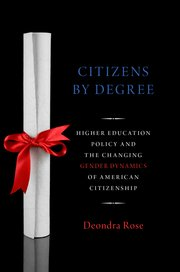
From the publisher: Since the mid-twentieth century, the United States has seen a striking shift in the gender dynamics of higher educational attainment as women have come to earn college degrees at higher rates than men. Women have also made significant strides in terms of socioeconomic status and political engagement. What explains the progress that American women have made since the 1960s?
For more information, click here.
Public Policy & Higher Education: Extra Credit
A high percentage of students attending college in the United States today are given some form of financial aid. But this wasn’t always an option. Professor Deondra Rose of Duke University’s Sanford School of Public policy discusses the history of higher education policy and how lawmakers have used programs like the National Defense Education Act of 1958, the Higher Education Act of 1965, and Title IX of the 1972 Education Amendments to expand access to equal opportunity.
To view this video, please click here.