

Firefighters and PFAS: Occupational Health and Environmental Health

Prof. Graham Peaslee from the Notre Dame Department of Physics discusses his recent research on PFAS, their impact on the body and the environment. A group of chemicals, Per- and Polyfluorinated Alkyl Substances (PFAS), was virtually unheard of by most of the public until 2012, when a study about their persistence in the environment was published. These chemicals are widely used, particularly in firefighting foams and gear, as well as in other consumer products. Prof. Graham Peaslee, in the Department of Physics, has examined PFAS use in a variety of these products. Learn the results of his recent research to find out what contact with this substance means for firefighters, and for you.
Experience the Event
Presented by Department of Physics
Prof. Graham Peaslee from the Notre Dame Department of Physics discusses his recent research on PFAS, their impact on the body and the environment.
A group of chemicals, Per- and Polyfluorinated Alkyl Substances (PFAS), was virtually unheard of by most of the public until 2012, when a study about their persistence in the environment was published. These chemicals are widely used, particularly in firefighting foams and gear, as well as in other consumer products. Prof. Graham Peaslee, in the Department of Physics, has examined PFAS use in a variety of these products. Learn the results of his recent research to find out what contact with this substance means for firefighters, and for you.
Meet the Faculty: Graham Peaslee
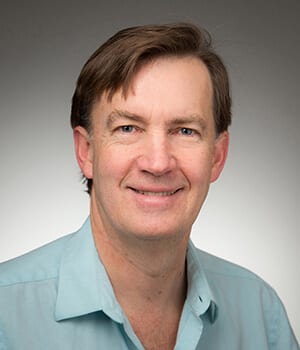
Graham Peaslee is a professor emeritus in the department of physics & astronomy at the University of Notre Dame. He was an undergraduate chemistry major at Princeton University, got a PhD in chemical physics at SUNY – Stony Brook, and did postdoctoral appointments at Lawrence Berkeley National Laboratory and the National Superconducting Cyclotron Laboratory. After 25 years of basic research in nuclear science, his research group developed a series of applied projects designed to use nuclear analytical techniques to investigate contaminants of environmental concern. These include measuring the fate and transport of non-point-source agricultural pollutants, heavy metals (including lead), halogenated flame retardants and per- and polyfluorinated alkyl substances (PFAS). He was hired to develop an applied Nuclear Physics program at the University of Notre Dame in 2016 and his research group continues to investigate environmental lead and PFAS in a wide range of environmental samples as well as in consumer products. He has active collaborations to study PFAS in Great Lakes fish, food packaging and textiles, plastics and personal care products as well as with Starfire Industries to develop a portable facility to measure total fluorine in the field for a rapid characterization of these pollutants. He also works with colleagues at U. Alabama – Birmingham, and U. Wisconsin – Madison and Texas A&M University to develop new methods for producing medical radioisotopes.