
Metaphysics of Prayer

If God is all-wise and all-good, why ask Him for anything? Fr. Stephen L. Brock invites us to explore this mystery through the lenses of C.S. Lewis and St. Thomas Aquinas. While Lewis offers an intuitive account, it faces significant theoretical hurdles. In contrast, Aquinas’s metaphysical approach, though more challenging, ultimately provides a deeper answer. Join us to contemplate how his vision honors divine transcendence while surprisingly granting our prayers a more powerful role in shaping the course of events in our world.
Experience the Event
Presented by Maritain Center
If God is all-wise and all-good, what is the point of asking Him for things in prayer? Fr. Stephen L. Brock, professor of medieval philosophy at the Pontifical University of the Holy Cross in Rome and a visiting professor of philosophy at the University of Chicago, considers how this question is answered by two Christian thinkers: C. S. Lewis and Saint Thomas Aquinas. Both regard petitionary prayer as a divinely instituted way of causing things. They differ widely, however, on how such prayer is related to God’s plan for the world. Lewis’s account is fairly easy to understand, and at least at first glance, it seems to be quite plausible. However, it runs into a serious theoretical difficulty, and how Lewis would evidently respond to this difficulty is, at best, counter-intuitive. Saint Thomas’s account is far more challenging than Lewis’s, because of all the metaphysics involved. On the other hand, for Thomas the aforesaid difficulty is no difficulty at all, and (Prof. Brock argues) his account not only does greater justice to the divine transcendence, but also, surprisingly, assigns to us—to our prayers and our actions—a far stronger role in determining the course of events in the world.
Meet the Speaker: Fr. Stephen L. Brock
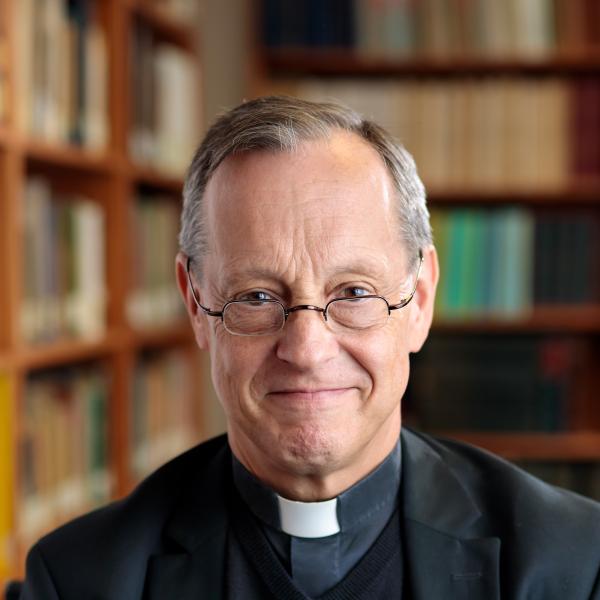
Since 1990 Fr. Stephen L. Brock has taught medieval philosophy at the Pontifical University of the Holy Cross in Rome. He was a visiting professor at the Catholic University of America in 1999, and at the University of Chicago starting in 2017. His research has been mainly on the thought of Thomas Aquinas, in the areas of ethics, action theory, and metaphysics, with occasional ventures into theology.