
What We Can Learn from Ukraine’s Fight for Democracy
Historian Olesya Khromeychuk challenges us to view democracy not as a static inheritance, but as a grueling “learning curve” forged in resistance. Centering on the concept of “hope as an emergency tool,” Khromeychuk reveals how Ukraine’s “hopeless hope” offers a strategic blueprint for collective survival and democratic perseverance in an increasingly uncertain global order.
Speakers include:
- Clemens Sedmak (Director of the Nanovic Institute for European Studies, Notre Dame)
- Olesya Khromeychuk (Director of the Ukrainian Institute, London)
- Michael Pippenger (Vice President & Associate Provost for Internationalization, Notre Dame)
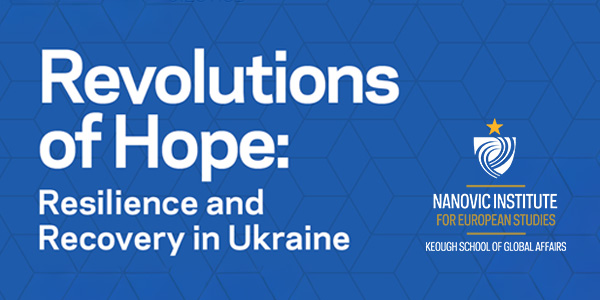
Revolutions of Hope: Resilience and Recovery in Ukraine is a collaboration between Notre Dame’s Nanovic Institute, part of the Keough School of Global Affairs, and Ukrainian Catholic University (UCU). The conference, hosted at the University of Notre Dame in March 2025, focused on the positive and corrective response to this destruction, exploring reasons for hope, sources of hope, and the politics and ethics of hope in Ukraine. How is hope powerful or even revolutionary? How does it encourage resilience and recovery? And, above all, how can we build and promote the integral development of hope in Ukraine? The conference explored the concept, dynamics, and practices of hope through keynote addresses, panel discussions, the arts, and liturgical observances. For more information visit the event website.
Co-sponsors included:
- Department of German, Slavic, and Eurasian Studies
- Kellogg Institute for International Studies
- Kroc Institute for International Peace Studies
- Notre Dame Democracy Initiative
- Notre Dame Global
- Office of the President, University of Notre Dame
- The Program of Creative Writing
- Raclin Murphy Museum of Art
- Ukrainian Catholic University
More Like This
Related PostsLet your curiosity roam! If you enjoyed the insights here, we think you might enjoy discovering the following publications.

The Gifts of Movement
Political Violence and Elections in Nigeria

“Slow Peace” and the Power of Civil Society
Revolutionary Ukraine: A History and Politics of Hope
Co-Creating Peace
The Political Life of the Novel